Analysis of Immigration and Discrimination in America
For centuries, the soil of the modern United States of America has been legendized and sought out. It has been termed the New World, the nation where cities are lined with gold, and the land of opportunity. As global curiosity increased in the last four hundred seventeen years, America's population has expanded from approximately 100 Englishmen to 334.9 million individuals of various ethnicities. As a preface, although this narrative focuses on United States history following the first English settlement, Jamestown, it is vital to note that the French colonized St. Augustine, Florida, in 1565, and the Spanish [Roanoke] in 1587. Continuing, while there are hundreds of ethnic groups in North America, to concentrate the topic, this report will specifically analyze the immigration and discrimination of Native American, European [including Irish], African American, Asian, and Mexican ethnicities from their first point of significant immigration to the United States of America.
Summarizing, long before Europeans colonized the Americas, Native tribes held a large population throughout the continent. However, Natives were inappropriately treated as invaders and decimated- their population faces discrimination to this day. Once English settlements successfully emerged in the 17th century, looking for labor, colonies began engaging in the Trans-Atlantic Slave Trade. The TASC lasted three hundred sixty-six years; Africans were forced from their homes and immigrated to the Americas and Europe as slave labor. Furthermore, the Potato Famine of Ireland prompted more than two million Europeans, primarily German, Irish, and Scottish, to mass migrate to the New World. Today, Pennsylvania is primarily German and Irish. Equally, California's Gold Rush influenced Asian [Japanese and Chinese] immigration, many of which settled in Hawai’i and California. Inversely, the initial U.S. population of Mexicans sprang as part of a land purchase; later, promises of citizenship in the form of indentured servitude promoted Mexican immigration. Finally, "In 1892, the federal government opened a new immigration processing center on Ellis Island in New York harbor… More than 70 percent of all immigrants… entered through New York City, which came to be known as the 'Golden Door'" (Library of Congress). Since then, immigration has skyrocketed- so has discrimination.
Native American
Preoccupation and Discrimination
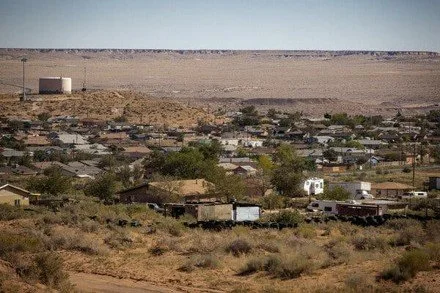
(Image One – Joseph Smith)
First, although the primary focus of this report is immigration, it is crucial to address the Native American population as the original inhabitants of American soil. Roughly five hundred years ago, before European colonization, the Native population exceeded a staggering one hundred ten million people. However, in 1607, European voyagers set forth to identify and conquer the New World, now known as the United States of America. Unfortunately, racial bias, territorial disputes, and fear led the Europeans to slaughter more than ninety percent of Natives between 1617 and 1619: a disastrous decline known as "The Great Dying." Although conflicts between the two groups persisted, the American Declaration of Independence [from Britain] in 1776 sparked more cause for concern.
To elaborate, American independence allowed voyagers to continue their goal of conquering as much of the New World as possible despite its present occupants. Subsequently, the United States government launched initiatives that would stain American morals for centuries. To begin, in 1786, the U.S. government set aside land for the first Native reservation in New Jersey; Natives were moved from their homes and to predestined plots. However, as government greed increased, so did their land acquisitions, and many colonists felt uncomfortable living near supposed savages (Monticello: Jefferson). Therefore, when President Jackson was inaugurated in 1829, the United States of America increasingly pushed Native people into the otherwise unexplored West. In fact, "In 1838… thousands of federal soldiers and Georgia volunteers entered the [Cherokee] territory and forcibly relocated the Cherokees, some hunting, imprisoning, assaulting, and murdering Cherokees during the process. Cherokees who survived the onslaught were forced on a 1,000-mile march to the established Indian Territory with few provisions. Approximately 4,000 Cherokees died on this 'Trail of Tears'" (Library of Congress).
Europeans’ pattern of pillaging persists until 1924 when President Calvin Coolidge finally "sign[s] a bill granting Native Americans full citizenship" (Library of Congress). Although the tensions between Natives and diluted Europeans (Americans) have been mitigated in the last one hundred years, discrimination persists, as well as reservations. For example, image one shows a modern Native American [Navajo] reservation in Arizona. As the image elaborates, Native reservations are placed in harsh, Western deserts, are considered independent, and are left without government or natural resources. Fun fact- Many reservations rely on casinos for income, which is why [Las Vegas] Nevada is known for them!
Conclusively, the once thriving Native population of one hundred thirteen million has dropped to less than nine million individuals as of 2023 (U.S. Census).
European
Immigration and Colonization
To preface, this section of “European” will encompass British, Irish, German, and Spanish immigration from 1607 to the present day.
To begin, in 1607, roughly one hundred British Europeans [and a few Germans] set sail for the New World and settled the infamous colony of Jamestown. In 1620, following the success of the Virginia colony, another one hundred men and women boarded the Mayflower and settled in Plymouth, Massachusetts. Shortly thereafter, the first American college, Harvard University, was established in 1636 (Harvard University). In Europe, the public caught wind of the colonist’s prosperity and survival, ultimately influencing their desire to mass migrate. Accordingly, Europeans began to flock to the British colonies by the thousands. One hundred forty years later, in 1776, America declared independence, and “the colonial population had increased to roughly 2.2 million residents…” (CATO); roughly half were enslaved Africans, and half were European. However, following America’s independence, European and African immigration remained steady, with no dramatic influxes to the colonial population for sixty-nine years.
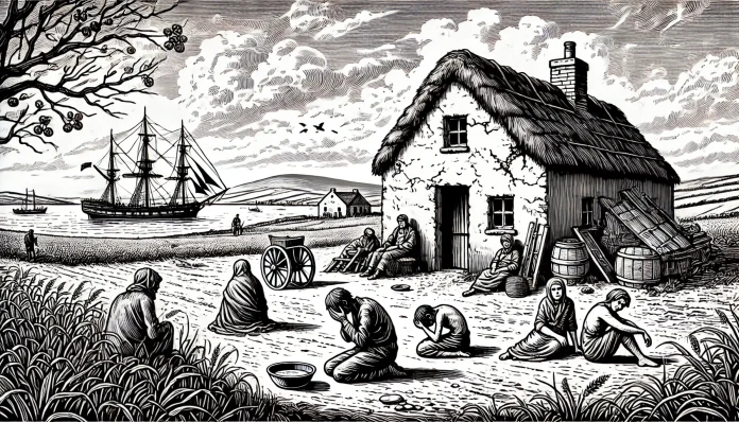
(Image Two – Aidan the Irelander)
Unfortunately, as depicted in image two, by 1845, “Potato crop fails in Ireland sparking the Potato Famine which kills one million and prompts almost 500,000 [European and Irish] to immigrate to America over the next five years” (Library of Congress). Irish, Scottish, and German immigrants began to form seclusive settlements; “The Irish arrived in Philadelphia…” (Poxon 28) and the Germans in Lancaster (Discover Lancaster). To elaborate, Germans brought a variety of religious beliefs to Pennsylvania, but three remain present: the Brethren, Mennonites, and Amish. Furthermore, Amish Germans [Anabaptists] concentrated in modern Lancaster, Pennsylvania, where 92,660 currently reside (“Amish Population 2024”).
Redirecting, in 1892, the United States Government established an immigration station on Ellis Island, New York, opening the door to millions of immigrants worldwide. Extraordinarily, according to the Pew Research Center, “[almost] 90% of the immigrants who arrived from 1890 to 1919 came from Europe.” The American government feared overpopulation, thus passing the Immigration Act of 1924. The 1924 Act implemented a quota system, placing a yearly numerical figure on persons allowed into the country via immigration. However, the Civil Rights movement [1965] influenced the banning of the quota system; it was replaced with a preference system that grants the United States government the ability to base an immigrant’s acceptance on their skills, criminal background, and familial ties.
Conclusively, in the United States, immigration modernly has a negative context, although nearly every American is a descendant of an immigrant. In fact, The United States of America Census classifies White Americans as automatic descendants of Europeans and has concluded that “European Americans” make up roughly 60% of the country’s current demographic.
African [American]
Forced Immigration, Dehumanization, and Discrimination
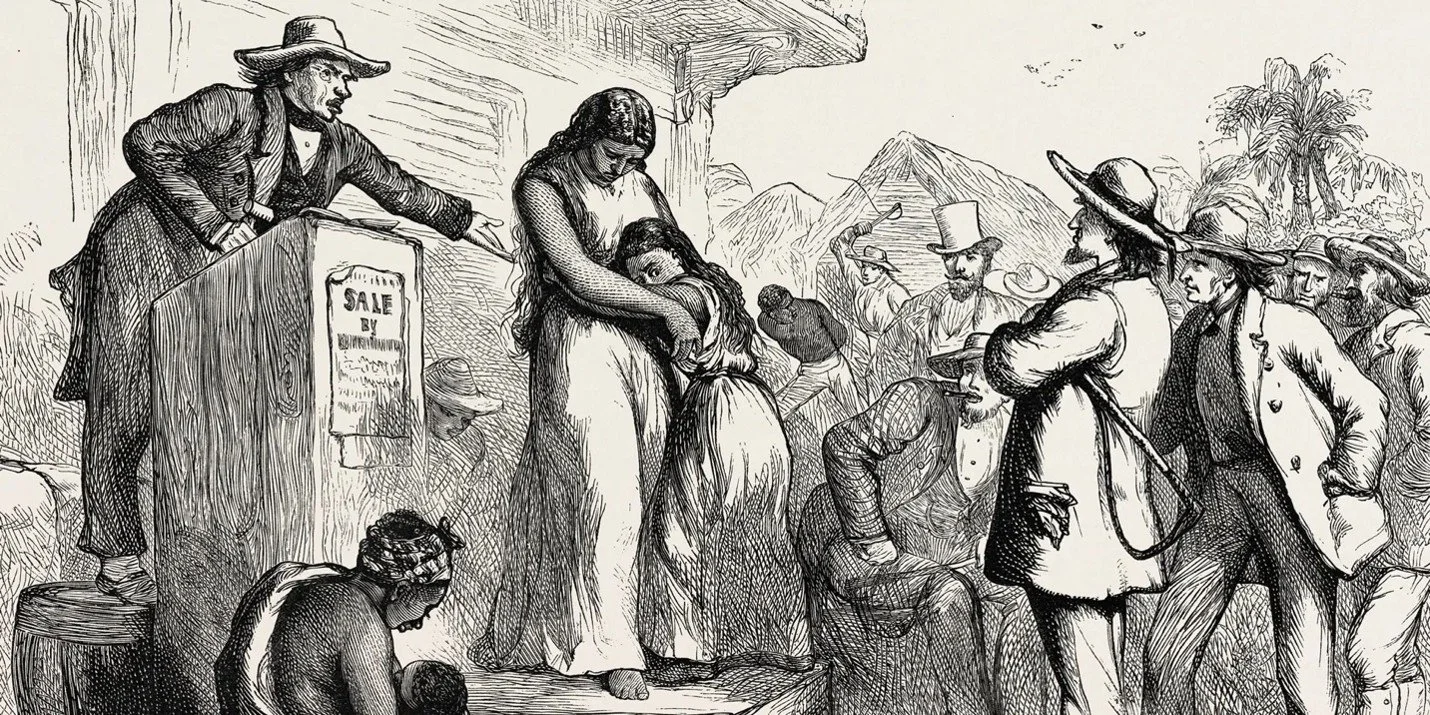
(Image Three – History.Com)
Along with Native Americans, Africans were ripped of their civil liberties in the name of European American expansion. To elaborate, paraphrased by the Library of Congress, “As European colonies in the Americas expanded… their governments increasingly looked…for a source of cheap labor to power their growing farms, mines, and plantations.” At first, the European Americans indentured British criminals who were exiled to the New World as part of Britain’s initiative to rid its country of immorality. However, the colonists resisted the transported criminals and shortly opted to engage with Spanish slave traders, who “…took these [African] men and women from their homes by force” (National Park Service) to sell or use them as servants. Therefore, by 1619, the British colonies saw roughly thirty enslaved Africans arrive at Old Point Comfort in Virginia, who were quickly sold [refer to image three] as farmhands, nannies, or other types of servants (History.com).
Considering enslaved Africans were seen as property, their historic population remained unclear until the United States Census began operation in 1790. At this point, there were over seven hundred thousand documented slaves- approximately 18% of the country’s population. Tragically, the European Americans objectifying view toward Africans prompted society to kill, beat, rape, and even eat Africans (Woodward). Due to the prevalence of owners impregnating their slaves, the population of Africans quickly became mixed with the European Americans, thus breeding modern African Americans. Unfortunately, it was not until 1808 when “Congress bans importation of slaves, (Library of Congress). Moreover, slavery was not made illegal until 1865, and segregation in 1965.
Although brief, the specific analysis of ‘immigration’ of African Americans is concluded, as it would be grossly negligent to think “of slaves as immigrants [, as] it stretches the meaning of that word to its breaking point. Enslavement was an experience so radically different from what was experienced by other migrants that the story of slavery does not fit into this paper’s narrative” (CATO).
Asian
Delayed Immigration and Discrimination
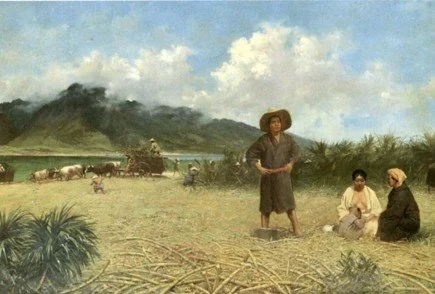
(Image Four – National Geographic Society)
While most immigrants came to the New World in the 18th century, Asians waited over two hundred years [after Jamestown] to flock to the United States. To begin with, in 1830, many Asians, specifically Japanese, started to immigrate to Hawai’i to work as sugar cane farmers, as illustrated in image four. However, it was not until the 1850 Californian Gold Rush that the United States saw its first major wave of Asian immigrants. According to the Library of Congress, of the 67,000 immigrants to California during the Gold Rush [1848-1855], 30% were Chinese! Although Asians came to America for gold, they found stable work in agriculture, factories, and fashion. Moreover, employers sought Asians as a source of cheap, legal labor, and “From 1865-1869, 12,000 Chinese immigrants constructed the western section of the transcontinental railroad – one of the greatest engineering feats in American history” (U.S. Department of Labor).
While the Asian population grew in numbers and cultural unity, America drifted into an economic depression, and European Americans “began competing with Chinese laborers for these jobs…” (Library of Congress). Subsequently, American society became anti-Chinese, and in 1882, Congress passed the Chinese Exclusion Act. The Act swiftly banned Asian laborers from entering the country, intending to free up jobs for angry, unemployed American citizens.
However, the act remained in effect until “World War II when it [Congress] lifted the ban on Chinese immigrants and established a meager quota in 1943…,” (CATO). Additionally, the entire quota system was dissolved in 1952, thus permitting Asians to move to America in the millions.
Lastly, although Asian immigration is relatively new [1830s], as of 2017, “there are over 160,000 Chinese American-owned businesses in the U.S., generating approximately $240[billion] in revenue and supporting 1.3[million] jobs [a year] …” (Committee of 100). As a personal reflection from a casino worker [me], Asian immigrants and descendants are the most affluent- I couldn’t imagine the industry without their contribution!
Mexican
Indentured, Deported, Immigrated, and Discriminated
(Image Five – National Geographic Society)
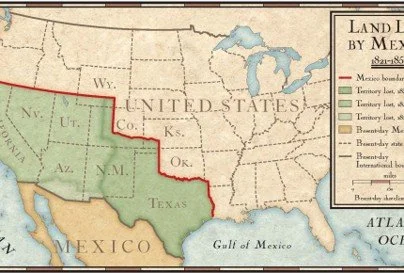
As of 2024, it is prevalent that “Mexico is the top country of birth for U.S. immigrants” (Pew Research Center). Nevertheless, few Americans understand the historical context surrounding the States’ sizeable Mexican population. To elaborate, for nearly two hundred years, America has comprised less than half of its current land, which was established on the East Coast [original colonies]. Then, in 1775, America declared independence from Britain, allowing the country’s resources to focus on expansion and innovation. Thus, the American government launched its initiative to own land “from sea to shining sea.” Between 1803 and 1853, the government succeeded in its goal by purchasing land from France, Great Britain, and Mexico, as illustrated in image five. However, the occupants of the land were not considered in any purchases, and “…almost overnight, tens of thousands of Mexican citizens had become residents of the United States” (Library of Congress). There were virtually no significant conflicts between White Americans and Mexican Americans until the start of the Great Depression in 1933; the American government “…thought that deporting illegal immigrants would create jobs…[the] government deported more than one million Mexicans…in what was euphemistically known as ‘repatriation,’ even though approximately 60 percent of the deportees were U.S. citizens,” (CATO). Paradoxically, when World War II began, American citizens were sent overseas, and jobs were left open in the agricultural industry, which women were unable to work due to societal standards. Therefore, in 1942, the American government instituted the Bracero Program, formally known as the Mexican Labor Program.
The program allowed American farmers to offer temporary labor jobs to Mexican citizens while Naturalized American men fought in the war. Although the laborers were paid considerably cheaply, the conversion rate from dollars to pesos is significant, meaning that the pay outweighed the costs for both workers and employers. Also, many Mexicans accepted positions of servitude with the hopes and promises of becoming legally naturalized and established afterward, thus indentured. The Bracero Program ran strong for twenty years, facilitating more than five million Mexicans to work legally within the United States of America (CATO). However, in 1964, the American government was pressured to end the program, as it was believed to infringe on civil rights- the topic up for debate at the time.
Conclusively, the labor program was closed, and labor costs increased, prompting farmers and construction company owners to move toward an underground market: cash. As the CATO Institute summarizes, “Ending the Bracero Program did not end temporary worker migration to the United States; it merely made such migration illegal.” Today, despite many Hispanics, specifically Mexicans, being historically Native to the United States of America, 76% of White Americans discriminate against Hispanics (Daniller).
Modern Relevance
In conclusion, with the focus on the modern United States of America, immigration is essential, as it is the country's foundation. As explored, Europeans migrated to the New World in the early 1600s, imposing on the Native inhabitants who viewed the settlers as encroachers that must be eradicated. However, the population of Europeans and their African slaves continued to grow and, first, relocated the Natives to reservations in unsupportive environments like the Western deserts. Secondly, when America declared independence in 1775, the "Established Americans perceived more recent arrivals as responsible for an increase of crime and poverty in the cities. They also viewed immigrant culture with suspicion." (Murrin et al. 380). This pattern where descendants of immigrants discriminate against first-generation immigrants is prevalent in America, where many people scream to "close the border!" If you are an American citizen, remember there is no such thing as a pure-bred American. Which group of immigrants is responsible for your existence and freedom?
A Few Immigration and Civil Rights Acts Listed in U.S. Constitution
[The] 1866 Civil Rights Act declared all persons born in the United States citizens, "Without distinction of race or color, or previous condition of slavery or involuntary servitude."
[The] 1868 Fourteenth Amendment extended liberties and rights granted by the Bill of Rights to formerly enslaved people.
[The] 1870 Naturalization Act extended naturalization rights to people of African descent and nativity while continuing to exclude other non-white groups, such as Asians.
[The] 1871 Civil Rights Act declared that anyone who acts under color of law to intimidate another is acting unconstitutionally. Moreover, the Act permitted individuals to sue corporations and/or officials believed to have violated the law.
[The] 1882 Chinese Exclusion Act placed an immigration ban on Chinese laborers for ten years. Exceptions were offered for teachers/students, tourists, and diplomats because the ban was strictly focused on employment.
[The] 1891 Immigration Act centralized the federal government's authority over immigration while expanding and defining the country's list of excludable and deportable immigrants.
[The] 1917 Immigration Act requires a prospective immigrant to complete and pass a literary test and pay an $8.00 tax fee [roughly $200 in today's money] before entering the states. As of 2024, filing for Citizenship costs roughly $750.00.
[The] 1921 Emergency Quota Act placed yearly limitations on the number of immigrants per country permitted to immigrate to America.
[The] 1952 Immigration and Nationality Act included the Asian race in the U.S. immigration quota system, thus lifting the previous exclusions on Asian immigration.
[The] 1964 Civil Rights Act banned segregation and discrimination based on race, color, religion, sex, and national origin (ethnicity).
[The] 1965 Immigration and Nationality Act replaced the quota system with a preference system, which allows the American government to decide whether an applicant may enter based on their skills, criminal background, etc.
[The] 2002 Entry Reform Act followed the infamous event of 9/11, and the Act enforced travel documentation, visa tracking systems, and border patrol.
[The] 2006 Secure Fence Act initiated the construction of a fence along the two-thousand-mile border between Mexico and the U.S., which has since been partially rebuilt as a wall following the 2017 Executive Order 13767.
Works Cited
Aidan The Irelander. “A Short History of the Irish Famine - Irelander.” Irelander, 19 July 2024, theirelander.com/a-short-history-of-the-irish-famine/. Accessed 24 Nov. 2024.
“Amish Population 2024.” Young Center for Anabaptist and Pietist Studies, Elizabethtown College. https://groups.etown.edu/amishstudies/population-2024/. Accessed 25 Nov. 2024.
Baxter, Andrew M., and Alex Nowrasteh. “A Brief History of U.S. Immigration Policy from the Colonial Period to the Present Day.” Cato.org, Cato Institute, 3 Aug. 2021, www.cato.org/policy-analysis/brief-history-us-immigration-policy-colonial-period-present-day. Accessed 11 Nov. 2024.
Committee of 100. “From Foundations to Frontiers: Chinese American Contributions to the Fabric of America.” Committee100.org, Committee of 100, 2018, www.committee100.org/wp-content/uploads/2021/07/ContributionAcrossAmerica_C100WhitePaper.pdf. Accessed 25 Nov. 2024.
Daniller, Andrew. “Majorities of Americans See at Least Some Discrimination against Black, Hispanic and Asian People in the U.S.” Pew Research Center, 18 Mar. 2021, www.pewresearch.org/short-reads/2021/03/18/majorities-of-americans-see-at-least-some-discrimination-against-black-hispanic-and-asian-people-in-the-u-s/. Accessed 25 Nov. 2024.
Discover Lancaster. “Pennsylvania Amish History & Beliefs.” Discover Lancaster, www.discoverlancaster.com/amish/history-beliefs/. Accessed 25 Nov. 2024.
Harvard University. “The History of Harvard.” Harvard University, 2023, www.harvard.edu/about/history/. Accessed 25 Nov. 2024.
History.com Editors. “Slavery in America.” History.com, A&E Television Networks, 25 Apr. 2024, www.history.com/topics/black-history/slavery. Accessed 24 Nov. 2024.
Library of Congress. “Global Timeline | Immigration and Relocation in U.S. History | Classroom Materials at the Library of Congress | Library of Congress.” Library of Congress, Washington, D.C. 20540 USA, www.loc.gov/classroom-materials/immigration/global-timeline/. Accessed 11 Nov. 2024.
---. “Immigration to the United States, 1851-1900 | Rise of Industrial America, 1876-1900 | U.S. History Primary Source Timeline | Classroom Materials at the Library of Congress | Library of Congress.” Library of Congress, Washington, D.C. 20540 USA, www.loc.gov/classroom-materials/united-states-history-primary-source-timeline/rise-of-industrial-america-1876-1900/immigration-to-united-states-1851-1900/. Accessed 11 Nov. 2024.
Marita Krivda Poxon. Irish Philadelphia. Arcadia Publishing, 2013, p. 28, books.google.com/books?id=pIIaS92pWB0C&pg=PA9#v=onepage&q&f=false. Accessed 25 Nov. 2024.
Monticello: Jefferson. “Jefferson and American Indians.” Monticello.org, 2019, www.monticello.org/thomas-jefferson/louisiana-lewis-clark/origins-of-the-expedition/jefferson-and-american-indians/. Accessed 24 Nov. 2024.
Moslimani, Mohamad, and Jeffrey S. Passel. “What the Data Says about Immigrants in the U.S.” Pew Research Center, Pew Research Center, 27 Sept. 2024, www.pewresearch.org/short-reads/2024/09/27/key-findings-about-us-immigrants/. Accessed 11 Nov. 2024.
Murrin, John M., et al. “10–2. Immigration and Nativism.” Liberty, Equality, Power: A History of the American People. Cengage, 2020. Page 380.
National Geographic Society. “Feb 8, 1885, CE: Japanese Immigrants Arrive in Hawaii | National Geographic Society.” Education.nationalgeographic.org, 19 Oct. 2023, education.nationalgeographic.org/resource/japanese-immigrants-arrive-hawaii/. Accessed 24 Nov. 2024.
National Geographic Society. “Land Lost by Mexico.” Education.nationalgeographic.org, 2024, education.nationalgeographic.org/resource/land-lost-mexico/. Accessed 24 Nov. 2024.
National Park Service. “Arrival of the First Africans in 1619 (U.S. National Park Service).” Nps.gov, 2024, www.nps.gov/articles/000/arrival-of-the-first-africans-in-1619.htm. Accessed 14 Nov. 2024.
Smith, Talmon Joseph. “With $32 Billion in Aid, Native Americans Push against History of Neglect.” The New York Times, 15 Oct. 2024, www.nytimes.com/2024/10/15/business/economy/native-american-tribal-lands-federal-aid.html. Accessed 24 Nov. 2024.
United States Department of State. “Chinese Immigration and the Chinese Exclusion Acts.” State.gov, 2016, history.state.gov/milestones/1866-1898/chinese-immigration. Accessed 14 Nov. 2024.
U.S. Department of Labor. “Hall of Honor Inductee: The Chinese Railroad Workers.” Department of Labor, www.dol.gov/general/aboutdol/hallofhonor/2014_railroad. Accessed 14 Nov. 2024.
Woodward, Vincent, and Dwight McBride. The Delectable Negro. NYU Press, 27 June 2014.